


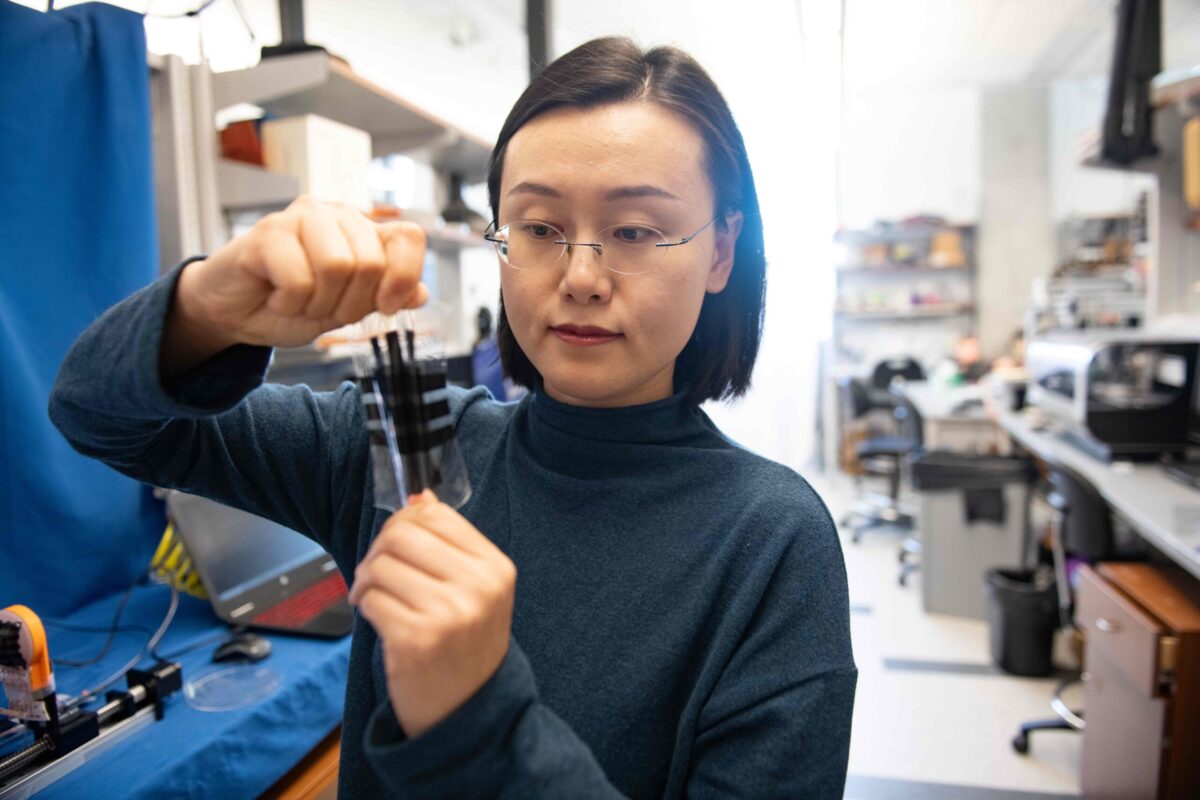
AUSTIN, Texas — A first-ever stretchy electronic skin could equip robots and other devices with the same softness and touch sensitivity as human skin, opening up new possibilities to perform tasks that require a great deal of precision and control of force.
The new stretchable e-skin, developed by researchers at The University of Texas at Austin, solves a major bottleneck in the emerging technology. Existing e-skin technology loses sensing accuracy as the material stretches, but that is not the case with this new version.
“Much like human skin has to stretch and bend to accommodate our movements, so too does e-skin,” said Nanshu Lu, a professor in the Cockrell School of Engineering’s Department of Aerospace Engineering and Engineering Mechanics who led the project. “No matter how much our e-skin stretches, the pressure response doesn’t change, and that is a significant achievement.”
The new research is published in Matter.
Lu envisions the stretchable e-skin as a critical component to a robot hand capable of the same level of softness and sensitivity in touch as a human hand. This could be applied to medical care, where robots could check a patient’s pulse, wipe the body or massage a body part.
Why is a robot nurse or physical therapist necessary? Around the world, millions of people are aging and in need of care, more than the global medical system can provide.
“In the future, if we have more elderly than available caregivers, it’s going to be a crisis worldwide,” Lu said. “We need to find new ways to take care of people efficiently and also gently, and robots are an important piece of that puzzle.”
Beyond medicine, human-caring robots could be deployed in disasters. They could search for injured and trapped people in an earthquake or a collapsed building, for example, and apply on-the-spot care, such as administering CPR.
E-skin technology senses pressure from contact, letting the attached machine know how much force to use to, for example, grab a cup or touch a person. But, when conventional e-skin is stretched, it also senses that deformation. That reading creates additional noise that skews the sensors’ ability to sense the pressure. That could lead to a robot using too much force to grab something.